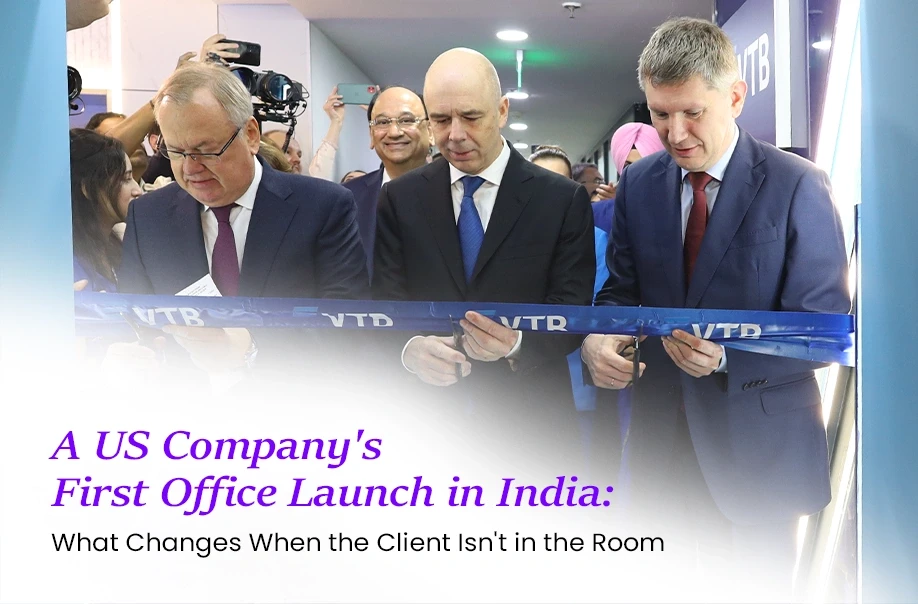
Most event planning assumes the client can walk the venue, eyeball the stage height, and settle an argument about seating in five minutes flat. That assumption breaks the moment your client is a US company launching its first India office and the actual decision-makers are sitting in California, or Austin, or New York, ten and a half to thirteen hours away depending on the season. If you're evaluating a corporate event management company in India for exactly this scenario, the honest first question isn't "can they design a nice stage." It's "can they run this whole thing when I'm asleep during most of the working day here."
Every India office launch brief covers the obvious things: headcount, venue type, budget range, whether leadership is flying in. What it rarely spells out is the operating rhythm that actually makes or breaks the project, because the client hasn't lived through a badly-run one yet. A US-based marketing lead signing off on an India launch is trusting a vendor with dozens of small judgment calls that would normally get a quick in-person check. Which caterer actually shows up on time. Whether the AV vendor's "confirmed" booking is really confirmed. Whether the security detail for a visiting SVP has actually been briefed, not just hired.

SKIL Events has direct experience with exactly this kind of US-led, remotely-managed India launch. Our work with Y Combinator's Startup School India debut in Bengaluru is a good example: a 2,500-attendee flagship event where the client, Maria Pacina, Senior Executive Assistant at Y Combinator, specifically credited the team's high ownership and clear communication as what made the distance manageable. That's not a coincidence. As an event management company in India for US companies, we've built our reporting and decision-making process around the fact that the client often can't be in the room, so the room has to come to them instead, through video, photos, and a single accountable point of contact rather than a scattered vendor list.
As a corporate event management company in India for US companies more broadly, we also handle the practical side that a first-time India launch often underestimates: local government approvals, venue contracts written in ways a US legal team can actually review quickly, and hotel and travel arrangements for any leadership flying in, all coordinated by the same team running the launch itself.
First-time India launches for US companies tend to stumble in predictable places. Budgets get quoted in a currency and format that doesn't map cleanly to how US finance teams approve spend. Timelines get built around US holidays without checking Indian ones, or the reverse. And communication defaults to whatever's convenient for the vendor rather than what actually works for a client checking updates once a day between other meetings. None of these are dramatic, but together they turn a straightforward launch into a stressful one.
Because a remote client can't verify most claims in person, trust has to be built through smaller, checkable proofs instead of one big pitch. That's usually references who'll take an unscheduled call, a portfolio that includes the messy parts of an event and not just the polished highlight reel, and a willingness to say, "that's not something we'd recommend," even when it means a smaller scope. SKIL Events believes transparent communication and practical guidance are essential when supporting clients from thirteen time zones away. Vendors who only ever agree with the client tend to be the ones a remote team eventually regrets hiring, because nobody was watching closely enough to catch problems early.
It also helps to agree upfront on what "done well" actually means for this specific launch, in writing, before planning starts. A US client and an India-based team can have very different instincts about what counts as a successful event, and SKIL Events helps establish clear expectations and measurable deliverables early. Surfacing that gap in week one is far cheaper than discovering it in the recap deck.
Yes, that's a large part of how we already work with US clients. Video walkthroughs, pre-packaged decisions and daily written updates replace the need for an in-person visit until the actual event.
Yes, including Y Combinator's Startup School India debut in Bengaluru, a 2,500-attendee flagship event specifically praised for high ownership and clear communication.
We package decisions into two or three fully worked options with pricing so approvals can happen quickly, and we keep one accountable contact for anything that needs a same-day answer.
Six to eight weeks is realistic for most launches, ten to twelve weeks for larger multi-day celebrations. Tell us your actual date and we'll tell you honestly what's achievable.
Can you also handle travel and hotel stays for visiting US leadership? Yes, travel, visas, hotel stays and ground transport for any visiting leadership are coordinated by the same team running the launch itself.