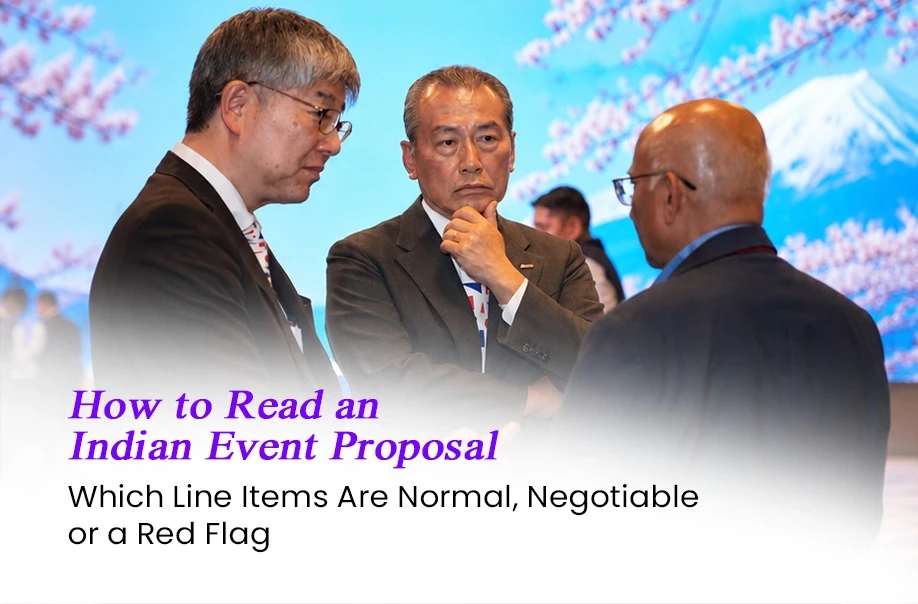
You've asked three agencies for a proposal and received three documents that look nothing alike. One has forty line items. Another has six. A third is a single number with a pretty picture.

If you're comparing a corporate event management company in India for the first time, especially from overseas, it's hard to know what's normal and what's a warning. Here's a plain guide to reading the page.
Most proposals follow a similar pattern: concept, programme, a cost sheet and terms. The cost sheet is where the truth hides. A good one breaks the event into clear groups, so you can see where money goes.
Typical groups include venue, food and drink, stage and sound, decor and fabrication, talent, manpower, travel, permissions, agency fee and tax.
These appear in almost every honest quote.
If you don't see these, ask why. A missing line often means the cost is hidden inside another number.
Some lines have real room to move, and a good partner will tell you where.
Our own volumes and long-standing vendor relationships help us negotiate better prices for clients, and a good partner should say the same.
Venue packages deserve special care. Many hotels sell a per-person food package with a minimum spend. That minimum can look generous or expensive depending on your guest count, so check the number of guests it assumes and what happens if fewer people attend.
None of these are bad. They just need an answer.
Some things are worth pausing over.
Compare these two lines. The first says, "Stage and sound: one lump sum." The second says, "Stage, sound and lighting for 200 guests, including setup, a rehearsal slot and two technicians on the day." The second tells you what you're buying and what to hold the vendor to. Always prefer that kind of line.
Honestly, a very low quote isn't a bargain. It usually means something has been left out, and you'll pay for it later.
Put the quotes side by side in a simple table with the same headings. Fill in each line, and mark any gaps. Then ask each agency the same three questions: what is not included, who is on site, and what happens if something goes wrong. You'll quickly see who has thought it through.
Ask how payments are split. A common pattern is an advance to confirm the booking, a second payment closer to the date and the balance after the event. Check that every payment has a clear invoice with tax details, and that the currency and bank details are agreed in writing.
Read the terms on changes and cancellation as well. What happens if the date moves, or the guest count drops by twenty per cent? A fair partner explains this calmly, before you sign.
A proposal is a promise. A reference call is the proof. Ask for two past clients with similar events, and speak to them for ten minutes. Ask what went well, what surprised them and whether the final bill matched the quote. People are usually honest, and the answers are worth more than any portfolio page. Any corporate event management company in India worth hiring will walk you through each line without hesitation. If they get defensive, treat that as useful information as well.
SKIL Events gives line-by-line quotes after a short discovery call, with a clear note on what's included and what isn't. With 24 years of experience and more than 1,500 events a year, we know where costs hide and where they can safely be trimmed. Whoever you hire, a best event management company in India will welcome your questions, not dodge them.
Many people also ask which is the top corporate event company India offers. Our honest answer: whichever one can show you named people, specific examples and a clear budget.
1. Compare proposals using the same headings.
2. Look for the normal lines, and ask about any missing.
3. Negotiate scale, format and volume.
4. Question vague totals.
5. Meet the on-site team before signing.
Concept, programme, a line-by-line cost sheet, a team list, timelines and terms. A contingency line is a good sign. Ask for sample pages from past events, with names removed. Reference calls help too.
If the scope is vague or key lines are missing, it's probably incomplete. Ask what is not included before comparing prices. A cheap quote that later grows is rarely cheap.
It varies, so always ask. Some quotes show prices before tax, which can change the total noticeably. Ask for a total including tax, so comparisons are fair.
Decor scale, talent fees, food format and gifts usually have room. Volume across several events can also help. A good partner will point these out for you. Ask early.
Yes. SKIL Events provides line-by-line quotes with clear inclusions and exclusions after a short discovery call. Ask us for a sample. We also share sample timelines.